Labour shortages and surpluses in Europe 2025
Last update date:
Published date:
Swedish is available via eTranslation, the European Commission's machine translation service.
Translate to Swedish | Important information about machine translation
This report analyses labour market imbalances across EURES countries in 2025. Although labour markets have eased since the immediate post-pandemic period, shortages remain pronounced in key sectors and occupations. This is driven by demographic change, skills mismatches, job quality issues and limited labour mobility. Addressing these challenges requires integrated policies combining skills development, activation, improved working conditions and better use of intra‑EU mobility.
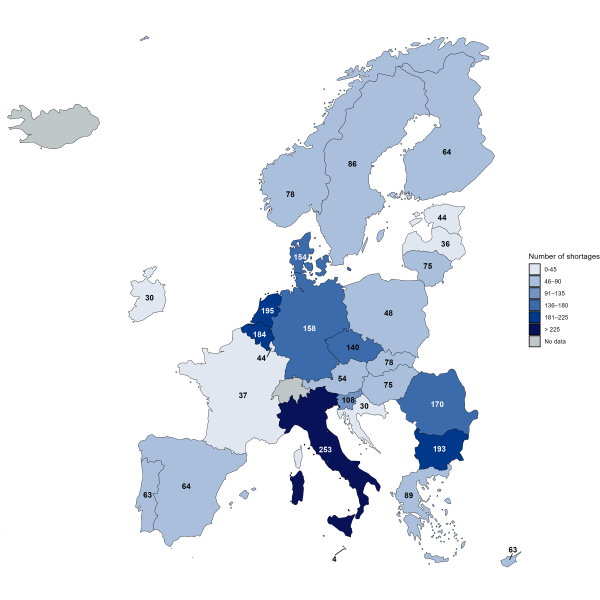
Numbers of shortage occupations identified, by EURES country, 2025
Labour shortages remain widespread, affecting nearly all occupations in at least one country (2 617 shortages reported). However, they are unevenly distributed, with a small number of countries accounting for a large share. Shortages are most common among professionals, trades and machine operators, including many medium‑skilled roles.
Surpluses (2 177) are more geographically concentrated and often affect clerical and elementary occupations. Importantly, many occupations appear in shortage in some countries and surplus in others, indicating untapped potential for cross‑border labour matching.
While the number of widespread shortage occupations, that is, those reported by more than half of countries, has declined, their severity has increased, suggesting shortages are becoming more concentrated and critical. Overall, imbalances are increasingly driven by long-term structural factors, requiring sustained policy responses such as improving job attractiveness, expanding training and supporting mobility.
Around one quarter of employment (53 million workers) is in occupations with widespread shortages or surpluses.
Shortages are particularly severe and persistent in health and care, which employs around 25 million people. Key roles- such as doctors, nurses and care workers - face widespread and critical shortages across countries. Addressing these requires improving working conditions, expanding training capacity and making better use of existing skills through innovation, digitalisation and organisational change.
Explore the shortages and surpluses 2025 interactive dashboard
Explore the ELA quantification of labour shortages and surpluses
Report on labour shortages and surpluses 2025
This annual report analyses labour market imbalances across EURES countries in 2025, highlighting increasingly structural labour shortages despite some post‑pandemic easing.
Annex - Report on labour shortages and surpluses 2025
English (458.14 KB - PDF)EURES Report on labour shortages and surpluses 2025: Analysis of generalist medical practitioners
English (1.85 MB - PDF)EURES Report on labour shortages and surpluses 2025: Analysis of health care assistants
English (1.65 MB - PDF)EURES Report on labour shortages and surpluses 2025: Analysis of nursing professionals
English (2.11 MB - PDF)EURES Report on labour shortages and surpluses 2025: Analysis of physiotherapists
English (1.52 MB - PDF)EURES Report on labour shortages and surpluses 2025: Analysis of specialist medical practitioners
English (2.1 MB - PDF)